
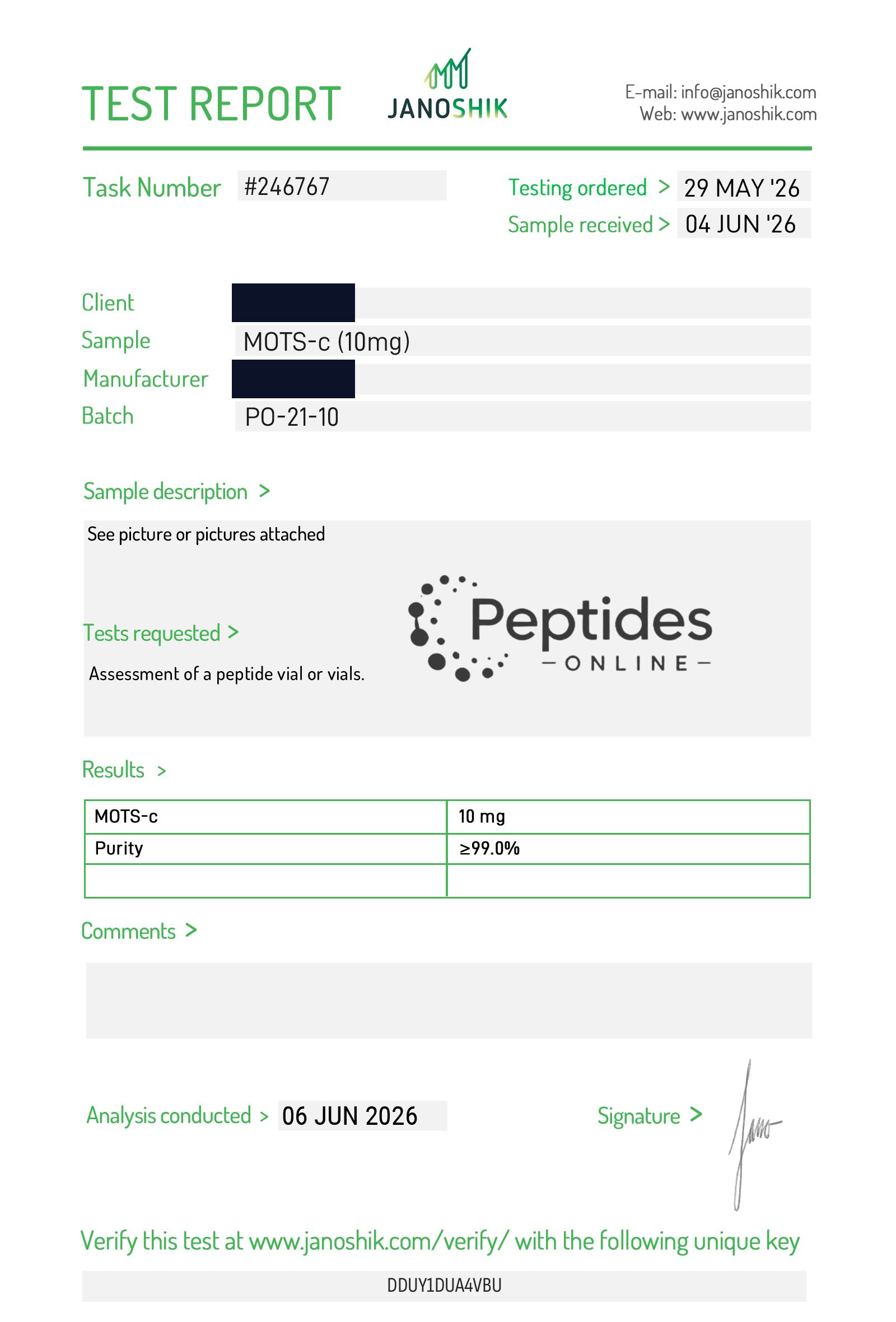
MOTS-c
Laboratory-grade peptide intended for scientific and analytical research use only.
- 16–amino-acid mitochondrial-derived peptide
- Studied in metabolic and exercise-physiology research
- HPLC-verified lyophilised research powder
Laboratory-grade peptide intended for scientific and analytical research use only.
The MOTS-c peptide is a mitochondria-derived peptide which is becoming a popular area of study in contemporary metabolism and longevity studies. The scientists are constantly exploring the possibility of how the natural peptide could affect the process of energy production, metabolism, and communication within mitochondria. With the increasing popularity of peptide science, MOTS-c peptide has become one of the hottest mitochondrial peptides in the scientific discourse.
Scientists working in areas such as metabolic physiology, exercise physiology, and healthy aging have shown growing interest in MOTS C peptide because of its unique biological nature and the ability to participate in cellular signal pathways. Nowadays, there are many research laboratories that require high-quality MOTS-c peptide for their studies. If you want to learn more about MOTS-c peptide and want to purchase it for your research, then learning about it is vital.
Many studies try to understand what MOTS-c is and why there has been so much attention focused on this molecule.
The peptide MOTS-c is a mitochondrial derived protein of 16 amino acids. Contrary to many other peptides, which are encoded in the nucleus, MOTS-c is encoded by mitochondrial DNA. Such an unusual structure has contributed to its value in terms of mitochondrial biology studies.
MOTS c peptide was discovered during the research on mitochondria intercommunication and their ability to regulate energy. As mitochondria are the energy generators in cells, scientists have tried to discover whether MOTS-c regulates cell's metabolic processes.
Research suggests that MOTS-c is involved in the regulation of metabolic pathways related to glucose consumption, energy balance and mitochondrial signaling. That is why MOTS-c has become increasingly interesting for researchers.
The MOTS-C acts as a signaling peptide that aids in promoting the process of communication between mitochondria and other parts of the cell. This process of communication, according to scientists, is essential for ensuring cellular energy balance and homeostasis.
A number of investigations on the MOTS C peptide have centered on how it affects the metabolism of glucose, insulin sensitivity, and energy utilization by cells. It is seen that the MOTS-c peptide interacts with energy and metabolic pathways, thereby making it important for metabolic researches.
The interest in MOTS-c peptide is also increasing in the field of exercise physiology. There are ongoing studies on how signaling peptides from the mitochondria help the body to adapt to exercise-induced stress. Since the health of the mitochondria is associated with aging, MOTS-c continues to be an important area of scientific research in relation to aging.
One of the most widely cited advantages of MOTS-c is its possible application in the study of metabolic diseases. Researchers have been looking into the ways in which MOTS-c affects glucose metabolism, insulin resistance, and general metabolic efficiency. This has helped to increase the attention to mitochondrial peptides and their effects on energy metabolism.
MOTS-c peptides have been tested for their effect on exercise adaptations and endurance associated physiological adaptations. Studies related to energy production and metabolism keep investigating the effect of peptides derived from mitochondria during physical exercises and recovery mechanisms.
Healthy aging is another field that has been extensively studied. In light of the fact that mitochondrial function alters naturally with age, the effects of MOTS-c on the processes involved have been studied. Studies such as these have fueled further scientific interest in MOTS-c.
Researchers have also investigated the correlation between MOTS-c peptide and metabolic efficiency. Studies have considered the impact of signaling pathways of mitochondria on energy utilization and fat metabolism. All these studies have been contributing towards the development of interest in the use of MOTS-c for metabolic studies.
However, it is important to emphasize that there is ongoing research on MOTS-c, and results of scientific studies need to be taken into consideration.
Many researchers seek information on the dosage of MOTS-c while reviewing scientific literature. But, what needs to be realized is that dosing protocols can be significantly different, based on the aims of each research, model used, and the overall experiment setup.
Currently, there is no universal dosing protocol for MOTS-c used in all types of research. Depending on the goals that need to be achieved, various studies will have different dosage schemes and concentrations.
It is essential to review scientific literature when analyzing MOTS C dosages and the experiments carried out. This helps to understand the methodology and protocol of each experiment. Proper handling of peptides is vital.
MOTS-c peptide remains the preferred choice for researchers because of its distinct mitochondrial nature and an increasing scientific literature base. In light of the rising interest in metabolic health and longevity studies, sourcing quality peptides is vital.
Quality MOTS-c peptide suppliers focus on quality tests and batch verification of the peptides in question. Many scientists prefer those peptides which have stringent manufacturing protocols and are clearly documented.
For researchers looking to purchase MOTS-c peptide, there are several factors to consider, including quality control aspects. Quality research materials aid in conducting credible studies.
Researchers selecting MOTS-c peptide should always review product specifications and quality documentation before use.
Correct storage is vital in ensuring that the integrity of MOTS-c peptide is preserved. The product should be stored in a cool place and should be protected from excess moisture and direct light. Refrigeration is usually advised.
Once the product has been reconstituted, it should be handled appropriately in the lab and any freezing and thawing cycles should be avoided where possible.
Buying MOTS C from a credible source means quality and transparency come first on your list. Researchers who are looking for MOTS-c peptide UK are usually those who have quality assurance through testing of the batches for purity and full product information.
In cases where one plans to buy MOTS-c peptide, one can look into choosing a company which takes quality control seriously in order to get reliable results in research.
With regards to metabolic research, mitochondria research, or healthy aging research, it is essential to get MOTS-c peptide UK.
MOTS-c is a mitochondrial derived peptide which has been identified in the recent past and is now under investigation for its possible applications in metabolic functions.
According to current research, the possible applications of MOTS-c could include the following areas: metabolic effects, exercise training adaptations, mitochondrial functions, and healthy aging research.
No established protocol for dosage of MOTS-c exists in the literature.
It is advisable to store the MOTS-c peptide following manufacturer’s instructions which include storing the peptide at a cold environment and avoiding exposure to light.
Individuals searching for MOTS-c peptide should go for well-known suppliers of MOTS-c peptide UK.
Note: The MOTS-c is a research peptide. At this time, it is not authorized as a medicinal product in the United Kingdom by the MHRA (Medicines and Healthcare products Regulatory Agency). The MOTS-c is only to be used for laboratory and scientific research and is not intended for any diagnostic, therapeutic, or preventive use in humans at all. Further research into the safety and efficacy of this product is being carried out currently.
Disclaimer: This article is strictly for academic and research purposes. MOTS-c is an investigational peptide. Evidence on its efficacy is limited to lab experiments and animal tests.
Compounds researchers commonly pair with MOTS-c.
Reviews
There are no reviews yet.