Copper peptides are short sequences of amino acids that chelate copper ions and thus acquire the properties of the peptide and copper ion together. Their place in the literature is somewhat unique as they were first described in human plasma over 50 years ago, and have been studied in various models of wound healing, connective tissue biology and, more recently, in gene expression studies. GHK-Cu is the most extensively studied member of this family, and serves as the benchmark compound for anyone interested in copper binding peptides.
The interest in copper peptides in the field of skin biology is born from where they were seen to be active – fibroblasts, extracellular matrix, and signalling that coordinates tissue repair. Copper peptides also appear frequently in longevity studies, as they are associated with the overall ageing of dermal tissue and the resilience of the cells.
This guide is a summary of the published research that is well replicated, and some which is preliminary. Written for laboratory and academic audiences and for educational and research purposes only.
What Are Copper Peptides?
A peptide is a polypeptide with a relatively small number of amino acids connected together by peptide bonds; peptides are shorter than proteins, and are sometimes short enough that their entire structure can be specified in a few letters. A copper peptide is one that has a sequence that coordinates a copper (II) ion in a stable complex with its own chemistry.
There are a number of such sequences that are found naturally. GHK (glycyl-L-histidyl-L-lysine) is the most well-studied and isolated from human plasma and subsequently found to be present as a triplet in the α2(I) chain of the type I collagen, implying it could be liberated by tissue damage related to proteolysis. Slightly less extensively, AHK, DAHK and the N-terminus of serum albumin which binds copper is studied.
The distinction matters. GHK is the free tripeptide, GHK-Cu is the copper bound complex, which is also referred to as the copper tripeptide or GHK-Cu²⁺. The activity is not observed with GHK alone or copper salts alone, suggesting that it is not merely an incidental consequence of copper coordination.
Understanding GHK-Cu
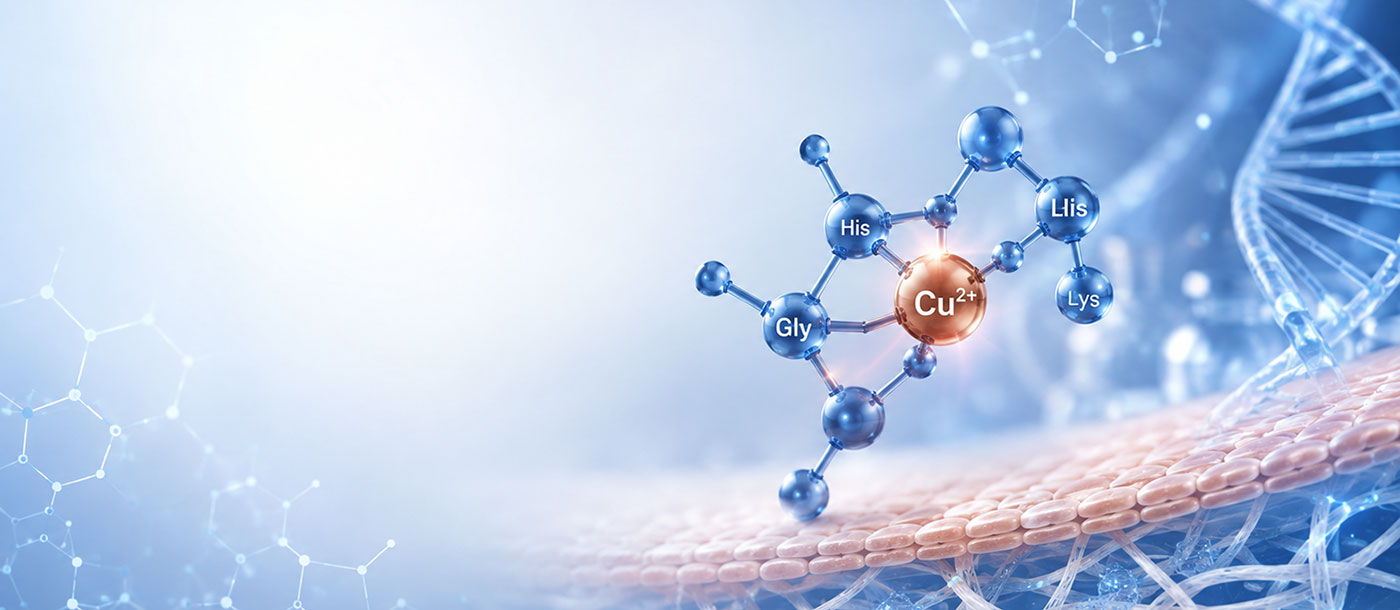
GHK-Cu is a copper tripeptide consisting of glycine, histidine and lysine. The imidazole nitrogen and the terminal amine and intervening peptide nitrogen combine to give the Cu ion a coordination geometry in which it binds tightly.
Copper has important biological functions. It acts as a cofactor for lysyl oxidase, which supports collagen and elastin cross-linking, and for superoxide dismutase, an enzyme involved in antioxidant defence. Peptides that reversibly bind copper are thus of interest for use as a possible transport or delivery vehicle, and this has long been a line of enquiry since the 1970s.
GHK has been reported to be present in human plasma at concentrations which are age dependent. This is often given as the reason that the peptide even entered into ageing research, although there is as yet no proof of the functional significance of the decline, and should not be interpreted as a proven cause of any age-related change.
Why Are Copper Peptides Studied in Skin Research?
The dermal tissue consists of fibroblasts and a relatively small number of other cells, with the extracellular matrix (ECM) being composed of collagen, elastin, proteoglycans, and glycosaminoglycans. Any compound that affects fibroblast behaviour or extracellular matrix turnover becomes a candidate for investigation in this system.
Evidence can be divided into three levels, and distinguishing between them is essential when interpreting the research
Cell culture studies provide the deepest level of mechanistic evidence. Collagen synthesis, glycosaminoglycan production, and metalloproteinase expression have all been investigated in cultured fibroblasts.
Animal models – Take those observations to the intact tissue models (principally rat and rabbit wound models), where the accumulation and repair of connective tissues are measured.
Human evidence remains the most limited, consisting primarily of small exploratory studies and post-procedural research. Any findings at the culture level must not be viewed as transferable and a lot of the published human work is not up to date with the methodological standards.
Biological Mechanisms Under Investigation
These are six mechanisms that are found repeatedly in the literature.
Cellular signalling. GHK-Cu has been studied as a modulatory agent of expressions of the growth factors, fibroblast growth factor, TGF-β1 and VEGF in cultured cells, suggesting it functions as a signal input rather than a material structure.
Copper transport. An early idea was that the tripeptide aids copper uptake into cells, and thereby provides copper to cuproenzymes. This is not established process, but a work in progress.
Matrix remodelling. Previous work with cultured fibroblasts has shown increased MMP-2 levels with increased secretion of both tissue inhibitors TIMP-1 and TIMP-2, a simultaneous acceleration of both degradation and restraint, which is typical of controlled remodelling rather than degradation.
Fibroblast communication. The effects on normal and irradiated fibroblast populations on proliferation and production of autocrine growth factors have been studied.
Antioxidant pathways. The complex has been reported to exhibit superoxide dismutase-like activity and to influence the iron-dependent in vitro lipid peroxidation process.
Gene expression. Transcriptional signatures of the peptide have been mapped using Connectivity Map analyses on large sets of genes. These are expression, not outcome, computational and cell-line based analyses.
Copper Peptides and Collagen Research
The common finding most often replicated is stimulation of collagen production in fibroblast culture. Maquart and co. have previously reported such an effect over the picomolar to nanomolar range, without any change in the number of cells — suggesting a per-cell synthesis effect, not proliferation. A tripeptide that is not structurally similar was inactive in the same system.
Later studies expanded this to a class of compounds called sulfated glycosaminoglycans, and ultimately in a wound animal model to detectable levels of connective tissue accumulation. All of these results suggest that this compound has a possible effect on matrix production and turnover in the systems studied.
They don’t talk about any cosmetic result. Biological plausibility is established by culture, animal studies, and does not support conclusions for visible or structural changes in human skin; studies of sufficient scale to address this question have not been conducted.
Copper Peptides and Skin Ageing Research
The study of skin ageing biology is focused on how the cumulative external load (mainly UV radiation, oxidative stress and external pollutants) interacts with intrinsic cellular ageing. Photodamage in particular is characterised by disorganised collagen, degraded elastic fibres and altered fibroblast phenotype.
The mechanisms listed above are all relevant to the above description, hence the interest of copper peptides in this field. The hypothesis was further supported by the reported age-related decline in plasma GHK.
None of this is proof of an ‘anti-ageing’ effect. What’s not yet clear, however, is the connection between such a compound that acts on these pathways in vitro and the ageing of a tissue in a living organism, and more studies are needed before any conclusions can be made.
Copper Peptides with Retinol
Copper peptides and retinoids are frequently compared in cosmetic science because both influence extracellular matrix biology through different mechanisms
The combination of copper peptides and retinol is found in many cosmetic science papers and formulations; this is because both components have a similar chain of action on matrix biology but through different pathways.
Retinoids are researched as nuclear receptor ligands. Retinol is converted to retinoic acid intracellularly, which binds RAR and RXR receptors, and can directly affect transcription; this is backed by a much larger amount of human data than for any peptide in this space.
Copper peptides function outside that system completely, via the above-mentioned extracellular and signalling pathways. The two are therefore compared, not as alternatives, but as two arms that share the same endpoints, thus being useful as contrasting arms in comparative study design.
They are not mutually replaceable; the differences relate to the issues of photostability and oxidation with retinoids, which do not occur with copper complexes, and to chelation and pH with the copper complexes, which do not occur with retinoids.
Copper Peptides Compared with Other Peptides for Skin Research
Several classes of peptides under investigation for skin research studies are examined in parallel with GHK-Cu for each with a different rationale.
Matrix signalling (palmitoyl pentapeptide-4) A matrikine type sequence derived from type I collagen, studied as signal peptide in the synthesis of matrices. It is not a biological feature but a formulation and permeation feature with its lipidated tail.
Palmitoyl peptides the matrix signalling compounds more generally (such as palmitoyl tripeptide-1 and tetrapeptide-7) and the compounds that affect inflammatory mediators are researched.
Acetyl hexapeptide-8 The other one functions in a different axis, which has been studied for its regulation of neurotransmitter release and interaction with the SNARE complex. It does not share any real mechanistic similarities with copper peptides.
Thymosin beta-4 is an actin-sequestering polypeptide studied in cell migration, angiogenesis and wound models – is closer to GHK-Cu in research context, but much larger, and mechanistically different.
BPC-157 A gastric peptide fragment that is studied primarily in models of connective tissue and angiogenesis and not a compound for skin research. GHK-Cu is unique among all these in terms of being a metal complex and so the chemistry of copper coordination is an intrinsic part of its mechanism and its analytical characterisation.
Current Areas of Copper Peptide Research
Active enquiry includes areas such as tissue regeneration and connective tissue biology, models of wound healing systems in a variety of species, ageing biology and cellular resilience, incorporation into biomaterials and scaffolds, where the peptide is considered as a bioactive part of self-assembling systems, regenerative medicine in general, cosmetic science, and work on peptide analogues and encapsulation for stability and delivery.
The most active and the least interpreted area of the past decade has been the study of gene expression profile. Creating large transcriptional datasets is easy and converting those into functional understanding is much more challenging, and hasn’t been fully bridged.
Research Quality and Laboratory Standards
Analytical rigour for copper peptide complexes is essential rather than a formality. Batch-specific Certificates of Analysis (CoAs) generated using high-performance liquid chromatography (HPLC) provide a direct assessment of purity rather than relying on generic specifications. Mass spectrometry is used to confirm molecular identity and, for copper peptides, to verify the copper-to-peptide ratio.
Variation from batch to batch is common and a known effect in peptide research, and results are often irreproducible due to the material used rather than the technique. Both the peptide backbone and the coordination complex are subject to stability and storage conditions, and analytical consistency between batches is the key to being able to compare results from different batches. These are the characteristics that will affect the ability to repeat a study.
Conclusion
The role of Copper peptides in cellular signaling, the extracellular matrix and tissue repair processes makes them an important area of scientific research, especially GHK-Cu. Laboratory studies are very good, but evidence from animal and human studies is developing. Their biological function and possible applications in research will be further elucidated by continued study in the fields of peptide chemistry, dermatology, and longevity.